The CCBHC compliance reports
every clinic must be audit-ready
Certification is the start, not the finish. Staying certified means producing a stack of federal quality, timeliness, cost, and grant reports on demand. Here is what a CCBHC has to report, and how to keep it audit-ready.
CurerTech Editorial Team
June 25, 2026 · 6 min
Key takeaways
- •A CCBHC is accountable for federal quality measures, timeliness standards, a PPS cost report, and grant outcomes, all at once.
- •Auditors rarely want a headline number; they want it broken down by age, race, and payer, on demand.
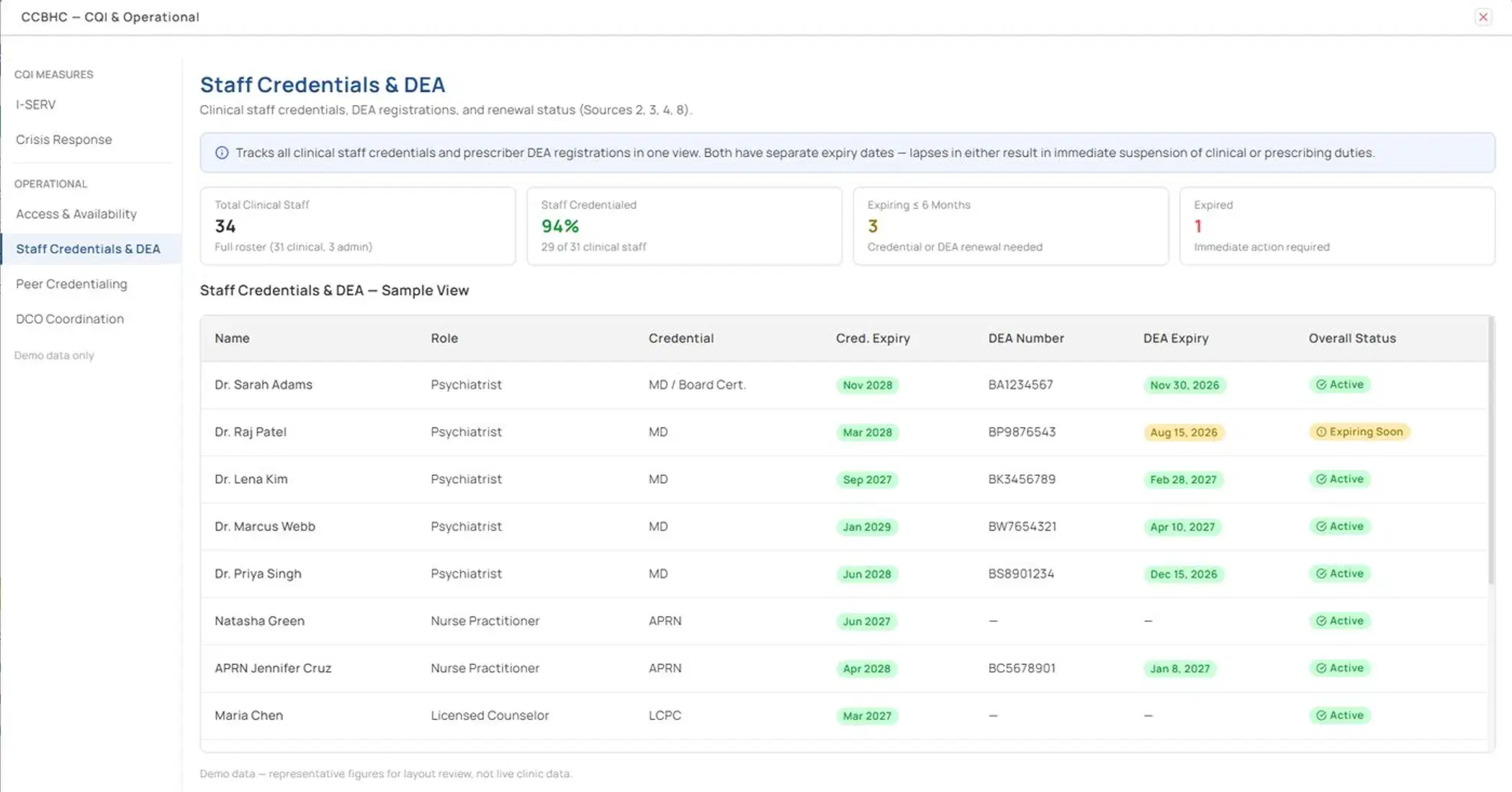
- •Credentials, DEA registrations, and corrective action plans have to stay current, not get reconstructed at audit time.
- •The clinics that cope treat these reports as continuous, not as an annual scramble.
Becoming a Certified Community Behavioral Health Clinic is hard. Staying one is a different kind of work. Certification opens the door; what keeps a clinic on the right side of it is a continuous stream of reporting that spans clinical quality, access timeliness, cost, and, for many clinics, federal grant outcomes.
The trouble is that these reports live in different systems, follow different schedules, and are usually assembled by hand when an auditor or a renewal deadline forces the issue. Here is the full picture of what a CCBHC has to produce, and what it takes to keep each piece ready rather than rebuilt.

CurerTech surfaces CCBHC quality, cost, and grant reporting in one platform. (11 slides)
Federal quality measures, all in one place
CCBHCs report a defined set of CMS-required quality measures, each scored pass-or-miss against a target, and many split between adult and child populations. The reporting itself is not the hard part; keeping every measure current and consistent across a year is.
CurerTech surfaces CCBHC quality measures in one platform.
Timeliness: the I-SERV measure
Access is a core CCBHC promise, and it is measured. The I-SERV measure tracks the time from first contact to initial evaluation and to the start of services, against the program's standard, with crisis response timeliness tracked alongside. Because timeliness is a moving target, it has to be monitored continuously; the gap between a referral and a first appointment is only useful while there is still time to close it.
The PPS cost report
The Prospective Payment System is what makes CCBHC financially workable, and it comes with an annual cost report to CMS. Done in spreadsheets, it is a month of reconciliation; done from the record, it is a report. For the underlying mechanics, see our guide on what PPS is.
An audit rarely asks for a number. It asks for that number broken down by age, race, and payer — and it asks today.
Grant reporting: NOMs and SPARS
Many CCBHCs also carry SAMHSA grant funding, which brings its own reporting: National Outcome Measures captured through instruments like PHQ-9, GAIN-SS, PCL-5, and WHO-DAS, submitted through the SPARS system with an acceptance history. Overdue measures are not a paperwork nuisance; they put grant renewal at risk. Keeping a live submission log, with what is due flagged before it lapses, is what keeps that funding secure.
The operational compliance auditors still check
Beyond clinical and financial reporting, a CCBHC audit reaches into operations:
- •Staff credentials and DEA registrations, with expiry tracked per person and renewal alerts before anything lapses
- •Financial audit findings, each tied to a corrective action plan and due date, with material weaknesses flagged
- •Service volume, unique and new clients, and crisis follow-up, tracked month over month
- •Board composition and DCO partnerships, kept current rather than assembled for the visit
None of these are hard to maintain continuously. They are very hard to reconstruct after the fact, which is exactly when most clinics try to.
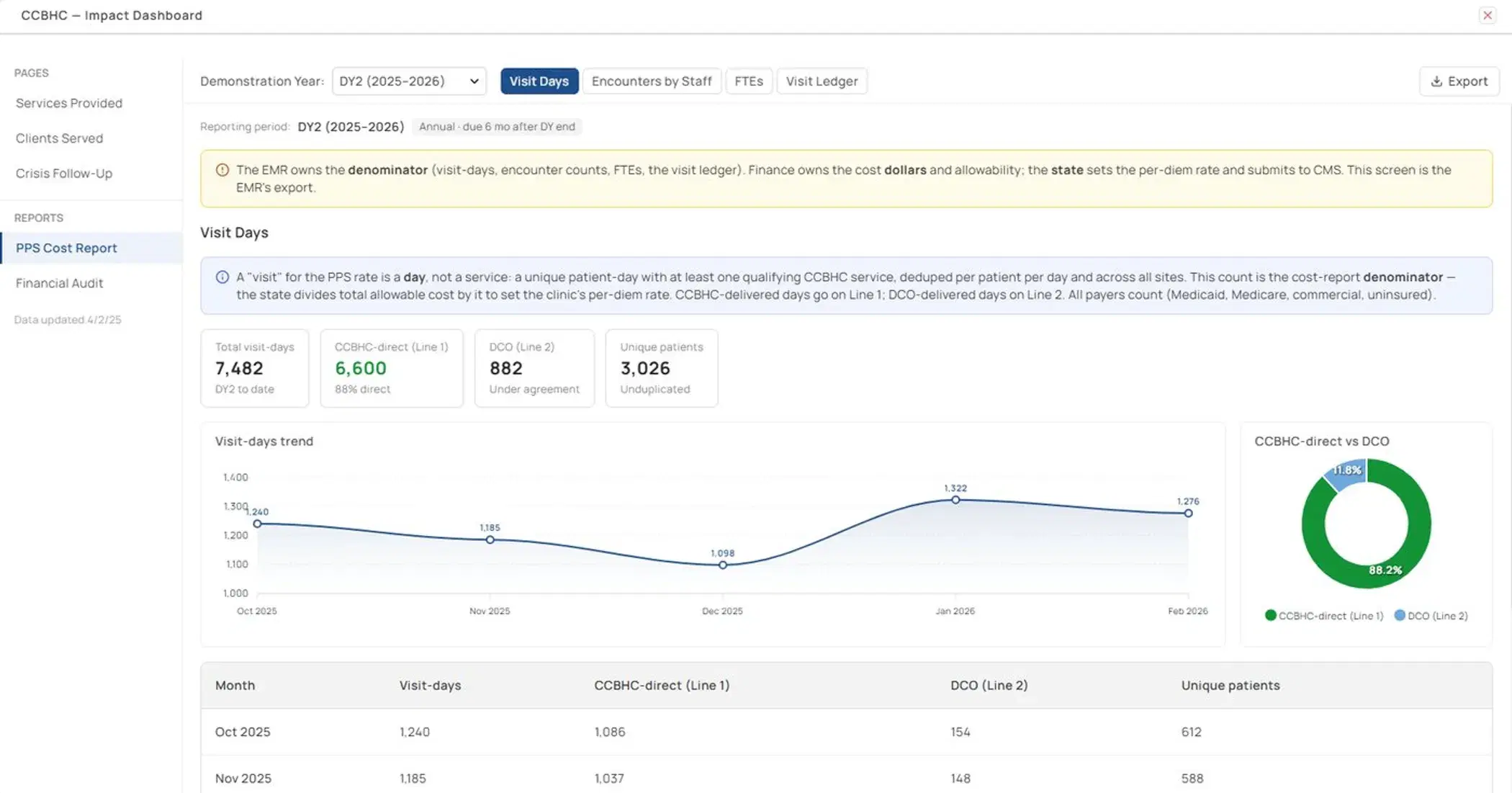
Service volume and trends tracked month over month, filterable on screen.
The real test: filterable, and current every day
The pattern across all of it is the same. An auditor seldom wants the top-line figure; they want it sliced by age, race, or payer, and they want it now. Reports that are built to filter on screen and export on demand turn that request from a fire drill into a click. (Where those breakdowns touch substance use records, the added confidentiality of 42 CFR Part 2 still applies, so disclosure controls have to travel with the data.) The clinics that stay calm at audit time are not the ones with better binders; they are the ones whose reports were never out of date in the first place.
Where CurerTech fits
CurerTech tracks these CCBHC reports in one platform, drawn from the same record that runs the clinic. The result is a clinic that is audit-ready every day, not just in the weeks before a visit. See the CCBHC platform, or see how CurerTech works.
CurerTech Editorial Team
Clinical and product editorial at CurerTech. This article is reviewed for accuracy by our team. Named author attribution and credentials are added as our editorial program rolls out.
Published June 26, 2026. CurerTech reviews and updates its guides on a regular cadence; check back for the latest.
Get started
See CurerTech built for your behavioral health clinic.
Walk through treatment plans, group notes, measurement-based care, and billing with our team.